Like many people, I’ve been thinking about AI and its role in our society for some months now.
I also consider it important to be honest with you, my reader.
That’s why I’ve decided to put together a statement on AI, which you’ll find below. I sent a draft of this statement to the thousands of readers subscribed to my email newsletter, and also to the members of my Scott Bartlett’s Spacers: Space Opera Fans Facebook group. Their feedback on the statement was overwhelmingly positive, and they helped me make additions to the statement which made it even more effective.
And so, after going through this process of consultation with my readers as well as professionals I work with to produce my books, I am publishing this as my personal policy as an author, when it comes to AI. Consider this my commitment to adhering to it.
I am publishing this on April 12th, 2024.
Statement on AI
(TL;DR: I’m not willing to let an AI insert anything into my work which I’m not aware of. Therefore, I won’t use AI to write for me. There’s a lot more than that covered in the statement, but for most readers that will probably be the most relevant point.)
For me, the use of AI boils down to two types of considerations: moral and prudential.
I realized recently that my thinking about AI had mostly been on the prudential side of things. Last summer (2023), I announced to my readers that I would rather be put out of business than use AI to write my books. That’s still true. (Incidentally, AI-written books putting me out of business is something I’m even less worried about now than I was then.)
But why is it true?
Well, my reasons have to do with prudence. If I start to rely on AI to write my books, then the more I do that, the worse I’ll become at writing.
The same goes for any technology, a term I’d define as anything artificial that we use to try to address the vulnerabilities of our fallen state as human beings.
Clothes are technology, technically speaking. So is writing itself. And just as the invention of writing things down made us worse at remembering, and calculators made us worse at mental math, relying on an AI to write for you will make you a worse writer. It’s pretty simple, really. And since I love writing, I want to get better at writing, not worse! Therefore, I won’t use AI to write for me.
Another prudential consideration has to do with the content that ends up in my published books. When I write a book, I inevitably include things in it subconsciously. I’ll include themes, conceits, and messages that I’m not aware I’m including. I know this because sometimes I spot them afterward, which indicates to me that there’s very likely a significant percentage of such subconscious content that I’m not aware of including.
So, what happens if I use an AI to help me write? If I were to do that, then even if I edited the AI’s input heavily, there would still be things it includes that I’m not aware of. I’d be willing to bet I’d remain ignorant of most of the elements it would include, just as I think it’s likely I’m unaware of most things that I subconsciously put into my work.
I’m not willing to let an AI insert anything into my work which I’m not aware of. Therefore, I won’t use AI to write for me.
You’ll notice that these are largely prudential reasons not to use AI to write my books (though they do have moral components to them).
But in light of the above, why wouldn’t I use an AI to design my book covers, instead of Tom Edwards? Why wouldn’t I get an AI to narrate my books, instead of Mark Boyett?
Well, there are prudential reasons for not doing that, too. My books have become inextricably bound up with Tom Edwards’ art style. They’ve become linked with Mark Boyett’s narration. Both these artists undeniably have a lot of talent, as well as followings of their own, and all of that tremendously benefits my books. Abandoning these artists would almost certainly hurt my career.
Again, that isn’t a primarily moral consideration, but a prudential one. And it also doesn’t fully address why I balk at using an AI for my book covers and narration.
Here’s where moral considerations come in. I really like Tom Edwards’ art, and it represents my work very well. The only way to even try to replicate that effect – prudential considerations aside – would be to try to get an AI image generator to mimic his style. That wouldn’t only be (very probably) illegal infringement; it would be unethical. Same goes for trying to synthesize Mark Boyett’s voice, or whatever the equivalent of that would be.
What’s more, both of these artists are human beings who understand the emotional components of their work. Maybe AI will get to the point where it can identify, with a high degree of accuracy, how a character should sound in a line of dialogue. But it will never understand the emotion it’s representing. Therefore, it can never be as good as a human at these things, and I don’t want it anywhere near my books. I don’t want it writing them, I don’t want it narrating them, and I don’t want it generating art to showcase them on a bookshelf.
Having said that, I don’t believe AI is inherently evil, just as I don’t believe any technology is inherently evil. Like any tool, it can and almost certainly will be used for evil. But it can also be used morally.
After spending more time recently thinking about the moral considerations involved in using this technology, I believe that the output of something like ChatGPT or Midjourney probably falls under the concept of fair use as it’s understood in international copyright law, so long as the output isn’t a copy of a human artist’s work. Artists have a reasonable expectation to make money from their work, but I don’t think they can reasonably expect to preserve it from all uses. Legally speaking, the relevant precedent here would probably be Google Books. Google digitized over 130 million books into their database, and they now let users search that database, while limiting them to the page or two surrounding the search result. Doing that has held up in court, and I expect a similar defense to be used by companies who make AI text and image generators. They aren’t actually showcasing the artists’ works to the public, and as long as they’re careful to build in protections against outputs being infringing, that activity will probably hold up in court.
I’m also sympathetic to the argument that pretty much everyone reading this right now already uses AI in some form in their day-to-day lives, whether they realize it or not. AI components are being added to everything – smartphones, social media, even spell checkers – often without the user even realizing he or she is using AI.
And in addition to the times I’m using AI and not realizing it, there are also deliberate uses that I would consider legitimate for my writing/publishing business.
Like I mentioned above, I intend to completely avoid using AI to write my books, or to package them, or to narrate them.
But here’s an example of where I would consider using it: training an AI model, for my own personal and exclusive use, on my own books. That would allow me to ask such an AI questions like “how does Thatcher like his coffee?” and get an answer right away, without having to search through multiple books when I need that info. I don’t really know how to go about doing this, and I haven’t looked into it seriously, but I would consider using AI in that way.
And if I ever got into dictating my books, I’d be open to using an AI to clean up the dictated text. Dictation software is prone to a lot of errors, and apparently AI is good at figuring out what you meant to say when you were speaking into the microphone. If I did do that, I’d want to look over the transcript myself immediately after, to make sure nothing but my intended prose made it into the book. Incidentally, I’m not likely to start dictating my books anytime soon – I much prefer typing them. But who knows what might happen in the future?
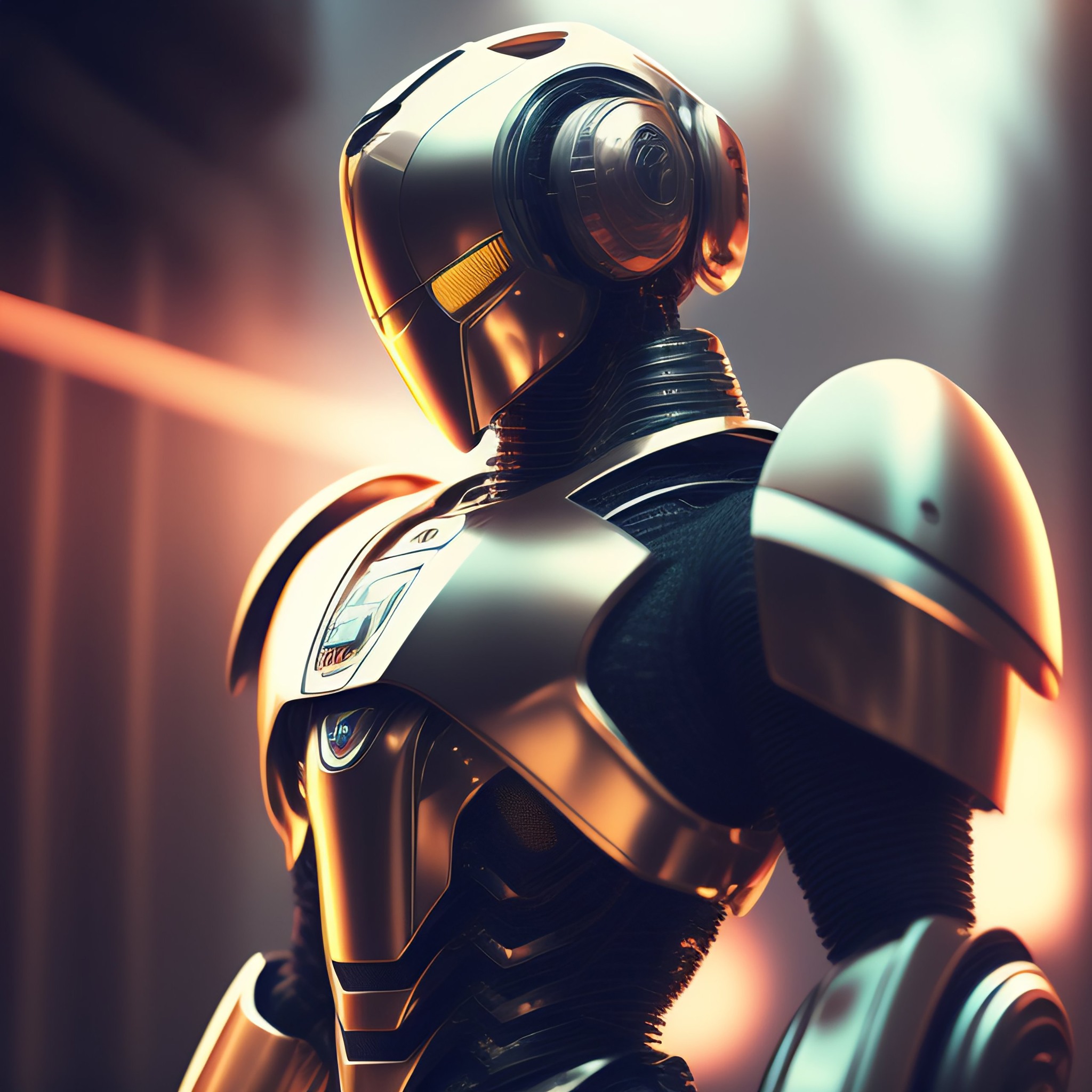
The final use I’m contemplating is using AI generated images in order to run Facebook ads. I’ve actually already done this, without intending to. You may have seen me use random sci-fi images on social media when announcing various things – these are images I’ve purchased licenses for from stock photo sites. But lately, I’ve run into AI-generated images being passed off as human creations on these sites. When I was collecting images to use in an ad campaign recently, I selected the filter to show only human-created images, no AI images, but according to feedback I got on my ads I still ended up with AI images, and I think those commenters are probably right about that.
Successful ad campaigns require testing a lot of ad images, and unfortunately, I can’t afford to pay an artist to create that many pieces of original art. My solution has always been to use stock images, but now it seems we’ve arrived at a point where I’m not able to tell which images are actually human-created and which are AI-generated. Admittedly, I’m probably pretty bad at telling the difference, but we may be approaching a point where it’ll be challenging for anyone to tell.
Ultimately, though, these are images I’ll use once or twice and probably never again. Do I care if they’re AI-generated? Not really. I don’t want AI art on my book covers, but it doesn’t really bother me to use an AI’s output as what is essentially a throwaway image on a Facebook ad or post, intended only to get someone’s attention while scrolling through the News Feed.
And like I said, I think image generators are very probably using artists’ work in a way that’s fair use, which seems morally acceptable to me.
The image generator I’m considering using for ad images is one made by a company that’s committed to only using royalty-free images to train its model. Of course, it’s impossible for me to know how faithfully that’s being implemented, but I at least find the company’s stated commitment to using only royalty-free images appealing. Even though I believe image generators are using existing artwork under fair use, provided that outputs aren’t infringing, it still seems most prudent to go with the option that at least claims to be using only royalty-free images to train its model.
If you have any feedback on this statement, please email me at scott@scottplots.com.
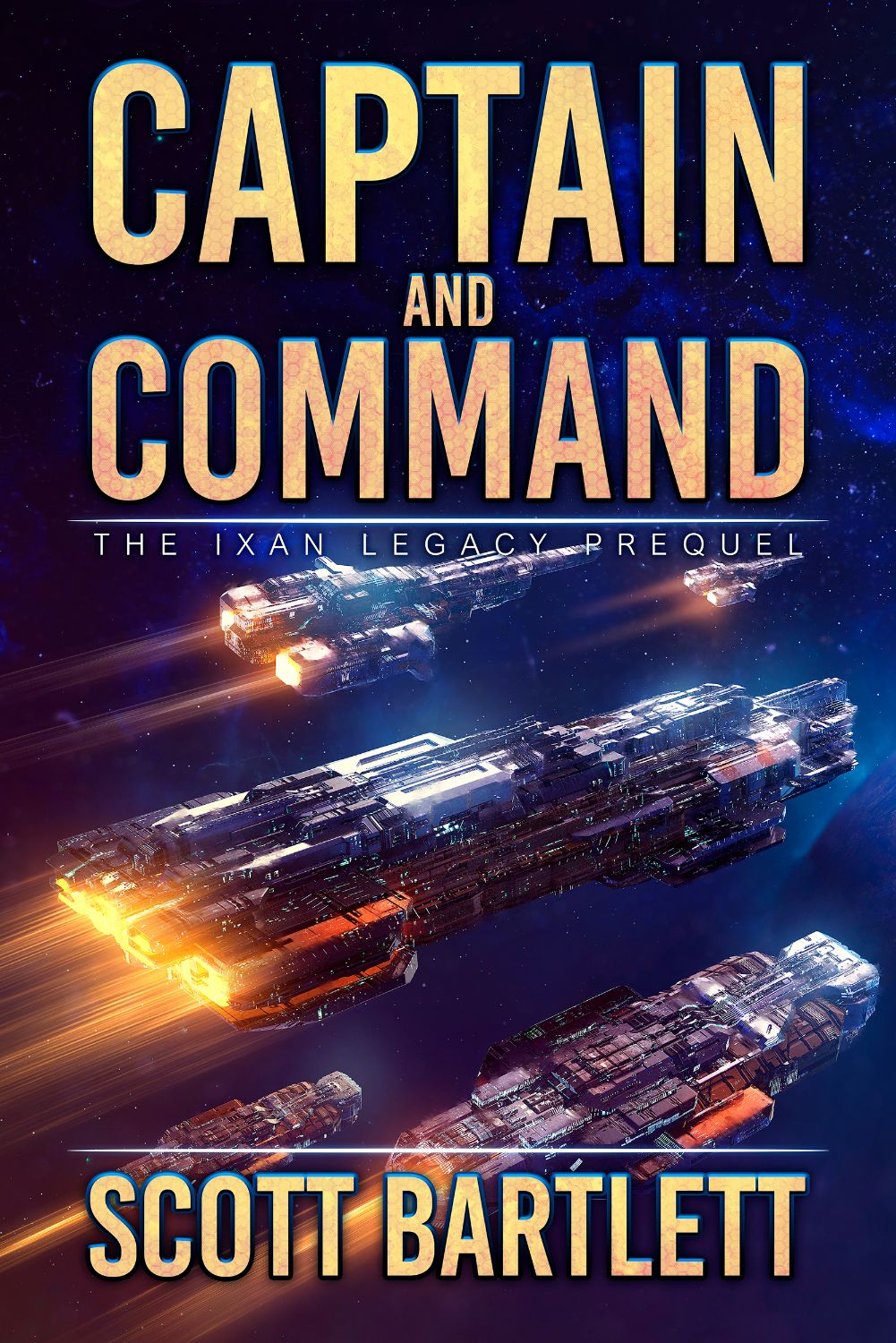
If you’d like to check out Scott’s work, currently you can download Captain and Command for free, along with 1 other military space opera ebook.